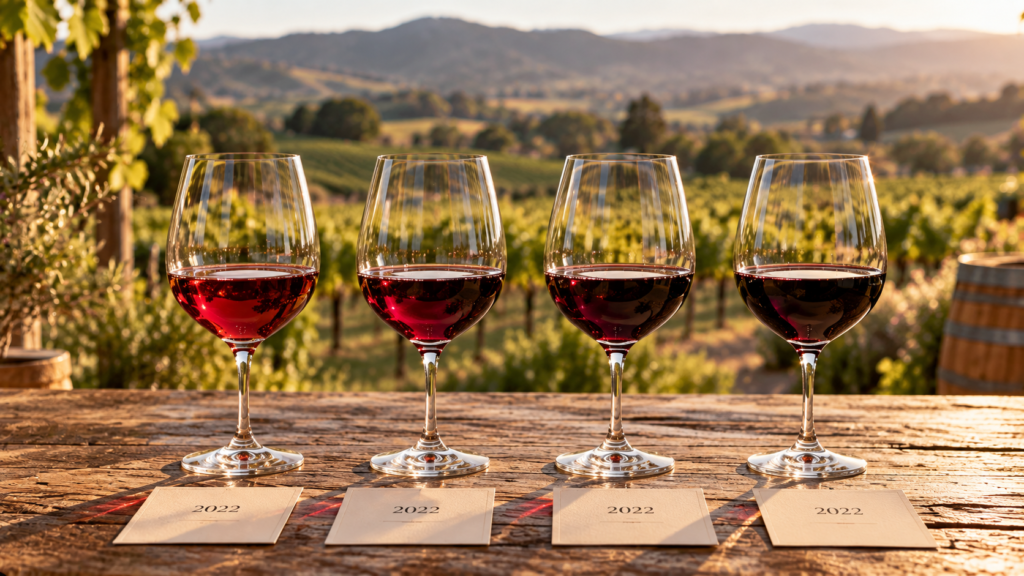
Imagine sitting at a table with four glasses of Cabernet Sauvignon. Each wine comes from the same vintage, but every glass offers a slightly different experience.
The first delivers vibrant dark fruit aromas. The second feels more structured, with noticeable tannins. The third introduces earthy notes, while the fourth offers a softer, rounder finish.
All four wines share the same harvest year.
Yet none tastes exactly alike.
This is the fascinating premise behind a horizontal wine tasting.
A horizontal wine tasting is a structured comparison of different wines produced from grapes harvested in the same vintage year. Traditionally, the wines also share a grape variety, region, or general style, allowing participants to explore differences between vineyards and producers.
Unlike an ordinary tasting flight, which might introduce several unrelated wines, a horizontal tasting creates a deliberate comparison.
The vintage remains constant while other characteristics change.
For example, comparing three Cabernet Sauvignons produced in Livermore Valley during the same harvest year can reveal differences associated with vineyard location, grape growing practices, and winemaking decisions.
Each bottle becomes another interpretation of a shared growing season.
That makes horizontal wine tasting particularly interesting for anyone who wants to understand why wines made from the same grape can offer dramatically different experiences.
It also provides an approachable introduction to the relationship between agriculture, craftsmanship, and flavor.
You do not need professional tasting credentials to appreciate these distinctions.
You simply need curiosity, a few carefully selected wines, and the willingness to pay attention.
How Horizontal and Vertical Wine Tastings Differ
Wine enthusiasts frequently encounter two educational tasting formats: horizontal and vertical.
Although their names sound technical, the distinction is straightforward.
A horizontal tasting compares different wines from the same vintage.
A vertical tasting compares different vintages of the same wine.
Consider the following examples.
| Horizontal wine tasting | Vertical wine tasting |
|---|---|
| Three Cabernet Sauvignons from the 2022 vintage | One Cabernet Sauvignon from 2020, 2021, and 2022 |
| Compares different wines | Compares different years of one wine |
| Highlights vineyard and producer differences | Highlights vintage variation and development over time |
| Keeps harvest year consistent | Changes harvest year |
| Explores diversity within a vintage | Explores continuity and change across vintages |
The distinction matters because each approach answers a different question.
A vertical tasting asks how a particular wine changes across growing seasons and, when bottle ages differ, how it develops over time.
A horizontal tasting asks how different wines compare when they originate from the same harvest year.
Neither approach is inherently more sophisticated.
They simply provide different ways to investigate the complexity of wine.
Why the Same Vintage Is Important
A vintage identifies the year in which the grapes used to make a wine were harvested.
Weather conditions during that year influence grape development.
Temperature, rainfall, sunlight, and the timing of seasonal changes can all affect the fruit entering the winery.
When wines share a vintage, tasters remove one major variable from their comparison.
However, the vintage does not guarantee identical growing conditions.
A vineyard on a hillside may experience different temperatures, drainage, and sunlight exposure than another vineyard several miles away.
Likewise, two wineries may harvest their grapes at different stages of ripeness.
A horizontal tasting therefore creates a more controlled comparison without eliminating every source of variation.
That balance is what makes the experience educational.
Why Comparing Wines from the Same Vintage Matters
Wine is sometimes discussed as though grape variety determines everything.
Cabernet Sauvignon should taste a certain way. Merlot should have a particular texture. Chardonnay should deliver familiar aromas.
These generalizations can be useful starting points, but they rarely tell the complete story.
Wine reflects a combination of grape genetics, environmental conditions, agricultural decisions, and production methods.
A horizontal tasting helps make those differences visible.
Or, more accurately, tasteable.
It Reveals Diversity Within Familiar Grapes
Someone who has only experienced one Cabernet Sauvignon may assume that every Cabernet Sauvignon tastes similar.
Comparing several examples from the same year challenges that assumption.
One might emphasize ripe black fruit.
Another might display herbal characteristics.
A third might feature pronounced oak aromas or a firmer tannic structure.
The grape provides a common foundation, but the finished wines can express different personalities.
This discovery often changes how people approach wine selection.
Instead of asking whether they like Cabernet Sauvignon generally, they begin recognizing which expressions of Cabernet Sauvignon appeal to them.
It Encourages More Attentive Tasting
Drinking one wine in isolation makes certain characteristics difficult to evaluate.
Is the acidity particularly bright?
Are the tannins unusually firm?
Does the finish seem especially long?
Without a comparison, these questions can feel abstract.
Placing another wine beside the first creates a reference point.
Suddenly, the differences become easier to recognize.
A wine that initially seemed full-bodied may feel moderate beside a more concentrated example.
A subtle aroma might become noticeable when contrasted with a wine that lacks it.
Comparison provides context.
And context helps transform vague impressions into meaningful observations.
It Separates Preference from Familiarity
People naturally gravitate toward flavors they recognize.
That familiarity can sometimes limit exploration.
A horizontal tasting introduces variation within a relatively consistent framework.
Because the wines share a vintage and potentially a grape variety, participants can investigate unfamiliar characteristics without jumping between entirely unrelated styles.
They may discover that a more restrained wine becomes increasingly appealing after several minutes in the glass.
Or they may realize that their favorite wine is not necessarily the richest or most expensive.
The important outcome is understanding personal preference more clearly.
What a Horizontal Tasting Can Reveal About Wine
A thoughtfully organized horizontal tasting can highlight several factors that contribute to a wine’s character.
However, it is important to recognize that tasting alone cannot always establish exactly what caused a difference.
Two wines might vary because of vineyard conditions, fermentation decisions, oak treatment, or a combination of influences.
The objective is to identify patterns and investigate plausible explanations.
Vineyard Location
Even vineyards within the same wine region can experience different growing conditions.
Elevation, slope, sunlight exposure, and surrounding geography influence the environment in which grapes mature.
A vineyard receiving abundant afternoon sunlight may produce fruit with different ripeness characteristics than one experiencing cooler conditions.
These differences can contribute to variation in flavor concentration, acidity, and structure.
When comparing wines from different vineyards, pay attention to recurring characteristics.
Does one wine feel brighter?
Does another seem more concentrated?
Are there differences in aromatic intensity?
Such observations provide a starting point for exploring the relationship between location and wine.
Soil and Water Availability
Soil influences how grapevines access water and nutrients.
Different soil compositions can affect drainage, root development, and vine vigor.
For example, well-drained soils may encourage different vine growth patterns than soils that retain substantial moisture.
These effects can influence grape development.
However, the relationship between soil and finished wine is complex.
It is generally more accurate to discuss how soil affects vine growth than to assume a particular mineral in the ground directly creates an identical flavor in the glass.
Horizontal tasting encourages curiosity about these relationships without requiring overly simplistic explanations.
Winemaking Decisions
The winemaker also plays a substantial role.
Two producers working with the same grape variety and vintage may make different decisions about fermentation, extraction, aging, and blending.
One might prioritize freshness and fruit expression.
Another might seek a more structured style.
Oak treatment can introduce additional variation.
Differences in barrel age, oak origin, toast level, and maturation duration can influence aromas and texture.
A horizontal tasting provides an opportunity to investigate how these decisions contribute to the finished wine.
How to Organize a Horizontal Wine Tasting
A horizontal wine tasting does not require an elaborate setting or expensive equipment.
The most important ingredient is a thoughtful selection of wines.
Start with a clear comparison question.
For example:
How do Cabernet Sauvignons from different Livermore Valley producers compare when they share the same vintage?
This question gives the tasting a purpose.
Without a defined objective, the experience can easily become an ordinary collection of unrelated pours.
Step 1: Select a Single Vintage
Begin by choosing one harvest year.
For illustration, imagine selecting three Cabernet Sauvignons labeled 2022.
Each wine should meet the same vintage requirement.
Do not substitute a 2021 bottle simply because it happens to be available.
That would introduce another growing season into the comparison.
If you cannot find enough wines from your preferred year, consider selecting a different vintage.
The goal is consistency rather than loyalty to a particular date.
Step 2: Choose Three to Five Wines
Three wines provide enough variety to make meaningful comparisons.
Four or five can introduce additional perspectives without overwhelming beginners.
Larger tastings are possible, but fatigue becomes an important consideration.
Repeated exposure to alcohol, acidity, and tannins can make subtle distinctions increasingly difficult to recognize.
Smaller pours and sensible pacing help maintain attention.
A focused tasting of four wines can be more informative than rushing through ten.
Step 3: Keep the Grape Variety Consistent
For a traditional horizontal comparison, select wines made primarily from the same grape.
Cabernet Sauvignon is one possibility.
Chardonnay, Merlot, Pinot Noir, and Sauvignon Blanc can also work.
Keeping the variety consistent helps reduce major differences caused by grape genetics.
It allows participants to focus more closely on vineyard expression and producer style.
A broader same-vintage tasting across different varieties is also possible, but it answers a different question.
That format explores varietal diversity rather than closely comparing equivalent wines.
Step 4: Prepare Consistent Serving Conditions
Serve comparable wines at similar, appropriate temperatures.
Avoid pouring one red wine immediately after removing it from a hot room while serving another at a cooler temperature.
Temperature can influence aromatic expression and perceived structure.
Use similar glasses whenever possible.
Different glass shapes can affect how aromas are concentrated and how wine reaches the mouth.
Consistent glassware helps minimize unnecessary variation.
Offer water and plain crackers or bread.
A neutral palate cleanser can be useful between samples.
If participants are evaluating several wines, provide a suitable container for spitting or discarding unwanted pours.
Step 5: Compare Before Discussing
Give everyone time to examine the wines independently.
Group discussion is enjoyable, but hearing someone announce that a wine smells like cherries can influence what others think they detect.
Independent observations provide a useful starting point.
Once participants have recorded their impressions, compare notes.
Differences in perception are part of the experience.
The objective is not to reach unanimous agreement.
It is to develop a more detailed understanding of the wines.
Choosing Wines for a Meaningful Comparison
Wine selection determines how useful a horizontal tasting becomes.
Randomly purchasing several bottles from the same year may produce an entertaining experience, but the results can be difficult to interpret.
A more intentional selection provides clearer comparisons.
Compare Different Producers Within One Region
This is one of the most traditional horizontal tasting formats.
Choose the same grape variety and vintage from several wineries operating within the same region.
For example, three Livermore Valley Cabernet Sauvignons from one harvest year could form a focused comparison.
Because the wines share a broad geographical setting, differences between vineyard sites and production methods become especially interesting.
Still, individual vineyards may experience significantly different microclimates.
The comparison controls the broader region, not every environmental variable.
Compare Different Vineyards
Another approach is to select wines sourced from different vineyards within a relatively small geographical area.
This format can be particularly revealing when the same producer makes comparable wines from separate vineyard sites.
Keeping the producer consistent may reduce some differences in winemaking philosophy.
However, a winery may intentionally use different techniques for each vineyard.
For that reason, vineyard-designated wines should be considered alongside information about their production.
Compare Different Regions
A broader horizontal tasting can feature the same grape and vintage from several wine regions.
Imagine comparing a California Cabernet Sauvignon with examples from other established Cabernet-producing regions.
The wines may reveal substantial differences in ripeness, acidity, aroma, and structure.
This format offers a broader geographical perspective.
However, regional comparisons introduce more variables.
Climate, vineyard practices, production traditions, and applicable wine regulations may all differ.
The tasting can illustrate diversity, but it should not be treated as a controlled scientific experiment.
Avoid Letting Price Define the Comparison
Price can influence expectations.
A participant who knows one bottle costs substantially more may unconsciously assume that it should taste better.
Consider concealing prices until the tasting concludes.
You can also conduct a partially blind tasting by covering labels and identifying bottles with numbers.
This encourages attention to sensory characteristics rather than reputation.
The resulting preferences may be surprising.
How to Evaluate Each Wine Side by Side
Once the wines are selected and poured, the next step is developing a consistent evaluation process.
The purpose is not to identify as many obscure flavors as possible.
Instead, focus on characteristics that can be compared reliably.
Begin with Appearance
Look at each wine against a neutral background.
Notice the color intensity and general appearance.
Are the wines similar shades of ruby?
Does one appear darker or more opaque?
Are there noticeable differences in clarity?
Color can offer clues about grape variety, extraction, age, and production methods.
However, darker color does not automatically indicate higher quality or greater flavor intensity.
Treat appearance as one observation rather than a final judgment.
Compare Aromas
Smell each wine before swirling.
Then swirl gently and examine the aromas again.
Notice whether the wines emphasize different characteristics.
Common aroma categories include:
- Fruit: Cherry, blackberry, plum, citrus, or apple.
- Floral: Violet, rose, or other flower-like impressions.
- Herbal: Fresh herbs, dried leaves, or green pepper.
- Spice: Pepper, clove, or cinnamon-like notes.
- Oak-associated aromas: Vanilla, toast, or cedar-like impressions.
- Earthy characteristics: Forest floor, dried vegetation, or mushroom-like notes.
These descriptors are comparisons to familiar smells, not claims that those ingredients were added to the wine.
You might notice blackberry in one Cabernet Sauvignon and red cherry in another.
That distinction is worth recording.
You do not need to determine its exact cause immediately.
Evaluate Acidity
Acidity contributes to the refreshing sensation of wine.
Higher perceived acidity often makes the mouth water.
Lower perceived acidity may create a softer impression, although sweetness, alcohol, and other structural elements influence the overall experience.
Taste the wines consecutively.
Which feels more refreshing?
Which seems rounder?
Does the acidity remain noticeable after swallowing or spitting?
Recording these impressions helps establish differences in structure.
Examine Tannins
Tannins are especially important when comparing red wines.
They contribute to the drying, sometimes gripping sensation experienced in the mouth.
Imagine the sensation of drinking strong, unsweetened black tea.
That drying quality provides a useful reference.
One Cabernet Sauvignon might display firm, persistent tannins.
Another might feel smoother and less drying.
Tannin intensity and texture can be influenced by grape characteristics, ripeness, extraction, and maturation.
Rather than describing one as automatically superior, consider how each wine’s tannins interact with its fruit, acidity, and overall structure.
Consider Body and Texture
Body describes the perceived weight of wine in the mouth.
A useful analogy is the difference between skim milk and whole milk.
Both are liquids, but they create different sensations of richness.
Wine can similarly feel light, medium, or full-bodied.
Alcohol, dissolved compounds, sugar, and other characteristics contribute to that perception.
Texture adds another dimension.
A wine may feel silky, firm, rounded, or particularly drying.
These sensations often become clearer when two glasses are compared directly.
Observe the Finish
The finish describes the sensations that remain after the wine leaves your mouth.
Some wines fade quickly.
Others leave lingering fruit, spice, acidity, or tannic impressions.
Pay attention to both duration and character.
A long finish is not automatically enjoyable if the remaining sensation feels unpleasant or unbalanced.
Likewise, a shorter finish does not prevent a wine from being appealing.
The question is how the finish contributes to the complete experience.
Understanding the Influence of Vineyard and Winemaker
One of the most rewarding aspects of horizontal tasting is recognizing that wine represents both a place and a series of human decisions.
A vineyard supplies the raw material.
The winemaker determines how that material is transformed.
Neither operates independently of the other.
The Vineyard Establishes the Starting Point
Grapes develop according to the conditions surrounding the vines.
Sunlight, temperature, soil moisture, vine health, and harvest timing all influence the composition of the fruit.
Even within the same region, these factors can vary.
Two vineyards separated by only a few miles may produce grapes with different sugar levels, acidity, and flavor development.
Those differences can carry through to the finished wine.
However, their expression also depends on the decisions made after harvest.
Harvest Timing Changes the Possibilities
Imagine two producers growing Cabernet Sauvignon during the same vintage.
One harvests earlier.
The other waits until the grapes reach a different stage of maturity.
The resulting fruit may differ in sugar concentration, acidity, and flavor characteristics.
Those differences can influence the finished wines.
Earlier harvesting does not automatically produce a more elegant wine.
Later harvesting does not automatically produce a richer or better one.
The outcome depends on the vineyard, weather, grape condition, and desired style.
A horizontal tasting can reveal contrasts consistent with different ripeness levels, although tasting alone cannot confirm harvest dates.
Fermentation Shapes the Result
During fermentation, yeast converts grape sugars into alcohol and other compounds.
Temperature, yeast selection, fermentation duration, and skin contact can influence the wine’s development.
For red wines, decisions about extraction are especially relevant.
A winemaker may use techniques that encourage greater extraction of color and tannins.
Another may pursue a gentler approach.
The resulting wines can differ in structure and texture even when they originate from similar fruit.
Aging Adds Another Layer
After fermentation, wines may mature in stainless steel, concrete, oak barrels, or other vessels.
Each approach can influence the finished product differently.
New oak may contribute noticeable aromatic compounds.
Previously used barrels may have a subtler aromatic influence while still allowing gradual oxygen exposure.
Aging duration also matters.
When comparing same-vintage wines, remember that they may not have been bottled or released at the same time.
A 2022 wine released after relatively short maturation may be at a different developmental stage from a 2022 wine that spent substantially longer in barrel.
The same vintage does not necessarily mean the same bottle age, maturation history, or drinking readiness.
That distinction is essential when interpreting horizontal tasting results.
Exploring Horizontal Wine Tastings in Livermore Valley
Livermore Valley provides an interesting setting for understanding same-vintage wine comparisons.
Located east of the San Francisco Bay Area, the region combines a long history of winegrowing with varied vineyard environments.
Warm daytime conditions and cooling influences associated with the nearby coastal environment help shape the region’s growing conditions.
However, Livermore Valley is not one uniform vineyard.
Differences in elevation, exposure, soil, and local climate can create meaningful variation between growing sites.
This diversity provides opportunities to investigate how wines from the same general region express different characteristics.
Why Livermore Cabernet Sauvignon Makes an Interesting Comparison
Cabernet Sauvignon is a familiar grape to many California wine drinkers.
That familiarity makes it a useful starting point for horizontal tasting.
Participants may already recognize common characteristics such as dark fruit, noticeable tannins, and oak-associated aromas.
Comparing several examples from the same vintage allows those familiar characteristics to become reference points.
One wine might emphasize freshness.
Another might display greater concentration.
A third might feature a different balance between fruit and oak.
Rather than treating these differences as contradictions, consider them expressions of the many factors involved in producing wine.
Mitchell Katz Winery’s Vineyard-Focused Approach
Mitchell Katz Winery, a family-owned producer established in 1998, emphasizes wines associated with identifiable Livermore Valley vineyard sources.
Its portfolio includes Cabernet Sauvignon and other red and white varieties, with selections varying according to release and availability.
That vineyard-focused approach provides a relevant connection to the principles behind horizontal tasting.
When wines carry vineyard designations, they invite questions about the relationship between growing location and sensory character.
Where were the grapes grown?
How did the vineyard’s conditions influence the fruit?
What production decisions shaped the finished wine?
These are precisely the kinds of questions a horizontal tasting encourages.
The winery’s broader selection also illustrates an important distinction between two educational formats.
Comparing a Cabernet Sauvignon and Merlot from the same vintage explores differences between grape varieties.
Comparing two Cabernet Sauvignons from different vineyards and the same vintage provides a more narrowly focused horizontal comparison.
Both experiences can be informative, but they should not be interpreted as identical exercises.
Mitchell Katz Winery’s standard tasting lineup rotates, and a dedicated same-vintage horizontal flight should not be assumed to be available on every visit.
Understanding Local Character Without Overgeneralizing
It can be tempting to assume that every wine from a particular region shares a fixed flavor profile.
In reality, regional identity is more nuanced.
Climate and geography create broad growing conditions, but individual vineyards and producers introduce variation.
Horizontal tasting makes that complexity easier to appreciate.
Instead of expecting every Livermore Cabernet Sauvignon to taste alike, participants can investigate what the wines share and where they differ.
That approach creates a richer understanding of regional character.
It also avoids reducing an entire wine region to a handful of tasting descriptors.
Developing a Deeper Appreciation for Wine Through Comparison
Wine appreciation does not depend on memorizing hundreds of grape varieties or identifying every aroma with perfect accuracy.
It develops through observation, experience, and curiosity.
Horizontal wine tasting brings those elements together in a practical way.
By holding the vintage constant, participants can investigate differences that might otherwise remain hidden.
They begin noticing how wines from the same grape variety can express different aromas, textures, and structures.
They learn that vineyard location matters, but that winemaking decisions also influence the final result.
They discover that a familiar wine category contains more diversity than its name might suggest.
Perhaps most importantly, they learn to separate expectation from experience.
A famous label does not guarantee personal enjoyment.
A familiar grape does not guarantee a predictable flavor.
And a shared vintage does not mean that every bottle will tell the same story.
For wine lovers exploring Livermore Valley, this perspective adds another dimension to the region’s vineyard-driven wines.
Mitchell Katz Winery’s emphasis on identifiable vineyard sources provides a natural context for appreciating the relationship between growing sites and individual wine expressions.
Yet the lessons of horizontal tasting extend far beyond any single winery or region.
They apply wherever different producers transform grapes from the same harvest year into distinct finished wines.
Ultimately, a horizontal wine tasting is an exercise in paying attention.
The glasses may share a vintage, a grape variety, or a geographical origin.
What makes the experience memorable is discovering how much individuality remains.
Every comparison offers another opportunity to understand wine not as a fixed set of flavor descriptions, but as the result of agriculture, environment, time, and human craftsmanship.
And sometimes, the most revealing discovery is simply that two wines you expected to taste alike are surprisingly different.
FAQs
What is a horizontal wine tasting?
A horizontal wine tasting compares different wines from the same vintage year. Traditionally, the wines also share a grape variety or region, allowing participants to explore differences in vineyard characteristics, winemaking techniques, and producer styles.
What is the difference between a horizontal and vertical wine tasting?
A horizontal wine tasting compares different wines from the same harvest year. A vertical tasting compares different vintages of the same wine. Horizontal tastings emphasize differences between wines, while vertical tastings highlight vintage variation and development over time.
How many wines should you include in a horizontal tasting?
Three to five wines generally provide a manageable starting point. This allows participants to identify meaningful differences without overwhelming their senses. Larger tastings are possible, but smaller selections encourage more attentive evaluation.
Can you compare different grape varieties in a horizontal wine tasting?
Yes. Wines made from different grape varieties but harvested during the same year can form a broader horizontal comparison. However, comparing the same grape variety across different vineyards or producers provides a more focused examination of vineyard and winemaking differences.
Do horizontal wine tastings require expensive bottles?
No. The educational value comes from thoughtful selection rather than price. Affordable wines from the same vintage can provide meaningful comparisons, especially when they share a grape variety or regional origin.