Mention California wine country, and a few famous destinations tend to dominate the conversation. Yet east of San Francisco Bay sits a wine region with deep historical roots, distinctive growing conditions, diverse grape varieties, and a community of producers who have been quietly making compelling wines for generations.
Welcome to the Livermore Valley wine region.
For people unfamiliar with Livermore, discovering its wine history can feel like finding an overlooked chapter in a book you thought you knew. This is not simply a newer destination trying to capitalize on California’s reputation for wine. Livermore Valley is one of California’s oldest wine regions, with commercial grape growing dating to the 1840s. The Livermore Valley AVA itself was established in 1982.
And its influence reaches well beyond the valley.
Livermore has played a meaningful role in the development of California wine, while its geography creates conditions particularly well suited to growing premium wine grapes.
Yet the region can still fly under the radar.
That combination, historical importance without equivalent mainstream recognition, is precisely what makes Livermore Valley so fascinating.
For wine lovers willing to look beyond California’s most famous labels and destinations, Livermore offers something increasingly valuable: a chance to understand a wine region through its vineyards, wines, winemakers, and sense of place.
What Does “Underrated” Really Mean?
Calling a wine region underrated does not mean claiming it is objectively “better” than Napa Valley, Sonoma County, or other celebrated California appellations.
Wine does not work that way.
Every serious wine region develops its identity through a combination of geography, climate, grape varieties, people, history, and winemaking traditions.
Livermore’s appeal is that the region possesses far more wine significance than many casual California wine drinkers realize.
It is the difference between fame and importance.
A musician can influence an entire generation without becoming the most famous name on the radio. In much the same way, a wine region can help shape an industry without becoming the first destination everyone associates with California wine.
Livermore Valley fits that description remarkably well.
Livermore Valley Has a Remarkable Wine History
To understand why Livermore deserves greater recognition, start with its history.
According to the Livermore Valley Wine Community, Robert Livermore planted wine grapes in the valley in the 1840s. During the early 1880s, major pioneers including Charles Wetmore, Carl H. Wente, and James Concannon established vineyards and wineries in the area.
Then came a milestone with international implications.
In 1889, a dry white wine from Charles Wetmore’s Cresta Blanca Vineyards won the Grand Prix at the International Paris Exposition. The achievement helped demonstrate that California could produce wine capable of receiving serious international recognition.
Consider the timing.
This happened nearly a century before California’s modern reputation as a global fine-wine powerhouse was firmly established.
Livermore was already part of the story.
Chardonnay and Petite Sirah Have Important Livermore Connections
The valley’s influence continued.
The Livermore Valley Wine Community reports that the first varietally labeled Chardonnay came from Wente Vineyards in 1936. In 1961, Concannon Vineyard produced the first varietally labeled Petite Sirah. The organization also notes that nearly 80% of California Chardonnay vines trace their genetic roots to a Livermore Valley clone.
These are not minor footnotes.
They help demonstrate how ideas, vines, and winemaking traditions associated with Livermore spread beyond the boundaries of the valley.
In other words, you may have encountered Livermore Valley’s influence without ever visiting Livermore.
The Livermore Valley AVA
Livermore Valley became an official American Viticultural Area in 1982.
TTB records show that the appellation was established on September 1, 1982, putting it among the relatively early AVAs established in the United States.
An AVA is more than a tourism label. It identifies a legally defined winegrowing area with distinguishing geographic characteristics.
For consumers, an appellation can provide context.
It tells you that the place printed on the bottle matters.
And in Livermore, place matters considerably.
What Makes the Livermore Valley Wine Region Different?
Wine begins as agriculture.
Before barrels, tasting rooms, labels, or scores enter the picture, there is a vine growing somewhere.
That “somewhere” shapes what happens next.
The French term terroir is often used to describe the combination of environmental factors that influence a vineyard and its grapes. Soil is part of the equation, but so are elevation, exposure, rainfall, drainage, temperature, wind, and numerous other variables.
Livermore Valley has a particularly interesting combination.
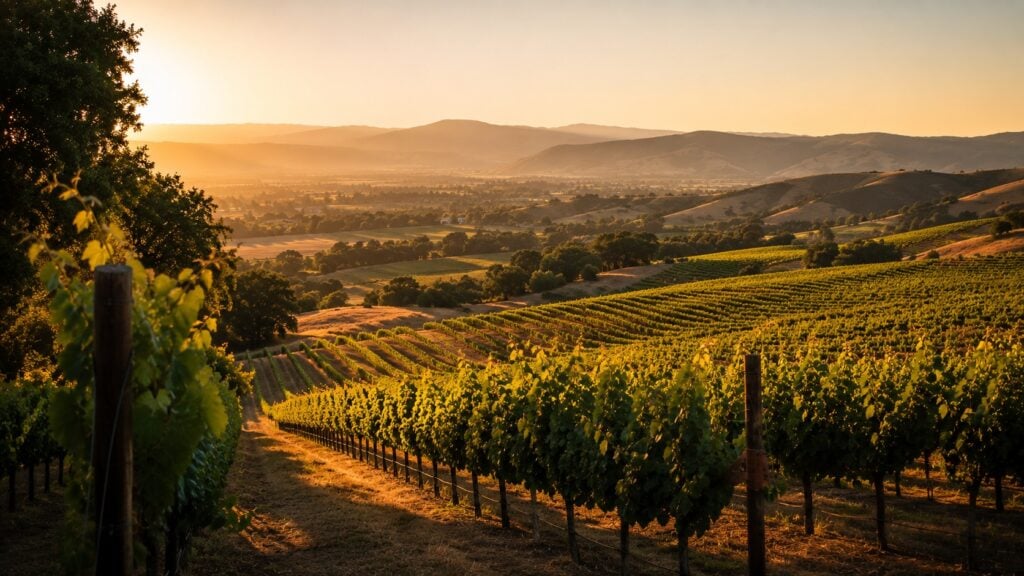
The valley sits roughly 30 miles east of San Francisco and has an unusual east-west orientation. It stretches approximately 15 miles east to west and 10 miles north to south, surrounded by mountains and foothills of California’s coastal ranges.
That geography helps connect inland warmth with cooling marine influence.
The result is one of the keys to understanding Livermore wine.
Warm Days and Cool Nights Create a Natural Advantage
Grapevines need sunshine and warmth to ripen fruit.
But heat alone does not automatically produce balanced wine.
Imagine cooking something over a flame with no way to regulate the temperature. More heat may speed things up, but speed is not necessarily the goal. Control matters.
A vineyard faces a comparable balancing act.
Warm daytime temperatures help grapes develop sugars, flavors, and physiological ripeness. Cooler conditions can slow the process and help preserve freshness and acidity.
Livermore’s geography gives the region access to both sides of that equation.
The valley’s east-west orientation helps channel coastal fog and marine breezes from the Pacific Ocean and San Francisco Bay into the area, cooling the warm inland air. Consequently, vineyards can experience warm days followed by significantly cooler evenings.
For grapes, that daily rhythm can be valuable.
Ripeness Without Forgetting Freshness
The goal in quality winegrowing is rarely simply to make grapes as ripe as possible.
Balance matters.
A grape can contain plenty of sugar but still lack the acidity, aroma, tannin development, or flavor complexity needed for compelling wine.
Livermore’s warm days encourage ripening, while its cooler nights can help grapes retain acidity.
That balance helps explain why the valley can successfully grow both powerful red varieties and expressive whites.
It also helps explain the range visitors encounter when exploring Livermore Valley wineries.
This is not a region defined by one grape alone.
Livermore Valley’s Soils Help Shape Its Wines
Climate receives plenty of attention in discussions about wine, but what happens beneath the vine matters too.
Livermore Valley is associated particularly with gravel-based soils and good drainage. The Livermore Valley Wine Community identifies these soils and the valley’s marine winds as important characteristics behind the AVA’s designation.
Why does drainage matter?
Grapevines generally do not need endlessly rich, waterlogged soil to produce high-quality wine grapes.
Some degree of limitation can actually be useful.
When vines have unlimited access to water and nutrients, they may devote tremendous energy to vegetative growth. In well-drained vineyard soils, vines can instead develop smaller berries and more concentrated fruit under appropriate farming conditions.
Think of it as the difference between giving a plant everything instantly and requiring its roots to work for resources.
The latter can produce interesting results in a vineyard.
One Valley, Many Vineyard Expressions
It is also important not to reduce Livermore to a single soil profile.
A detailed study commissioned by the regional winegrowers association examined differences in climate, terrain, geology, and soils throughout the AVA, reflecting the diversity that exists within the broader appellation.
That variation becomes particularly interesting when wine is produced from individual vineyards.
Two vineyards may sit within the same AVA but experience different slopes, exposures, soils, wind patterns, and microclimates.
Those differences can ultimately show themselves in the glass.
Livermore Is About More Than Cabernet and Chardonnay
Cabernet Sauvignon and Chardonnay have important places in Livermore’s story, but stopping there would give an incomplete picture.
The region supports an impressive range of varieties.
The Livermore Valley Wine Community notes that local vineyards include familiar varieties such as Merlot and Chardonnay alongside Italian, Rhône, and Spanish grapes.
That diversity makes exploring Livermore especially interesting.
A visitor can encounter structured Cabernet Sauvignon, aromatic white wines, robust Petite Sirah, Zinfandel, Merlot, Cabernet Franc, Petit Verdot, Malbec, Sangiovese, Syrah, and other styles depending on the producer and vineyard.
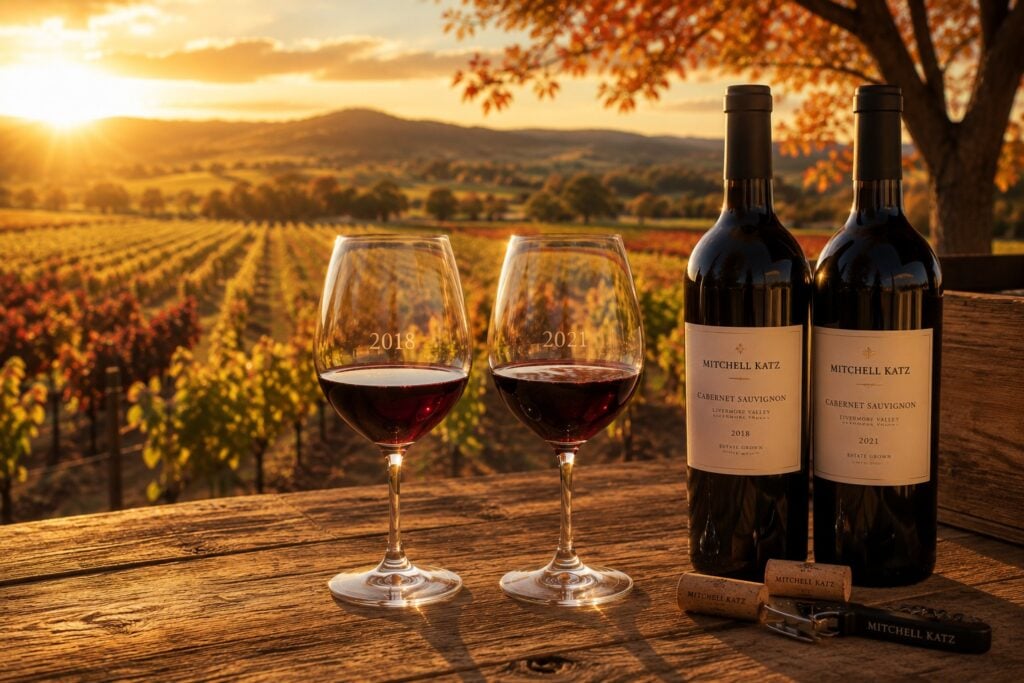
At Mitchell Katz Winery, for example, the current portfolio illustrates that range with Livermore Valley Cabernet Sauvignon, Zinfandel, Merlot, Petite Sirah, Malbec, Sangiovese, Syrah, Petit Verdot, Chardonnay, Sauvignon Blanc, and blends among its recent releases and listings.
For curious drinkers, that means Livermore can function almost like a wine classroom.
Instead of arriving with one predetermined “regional grape” in mind, you can taste how different varieties respond to the valley.
Small Wineries Give Livermore Wine Country Its Personality
A wine region is not defined solely by what grows there.
The experience surrounding the wine matters too.
One of Livermore’s strengths is the variety of producers operating within a relatively concentrated area. The regional wine community reports more than 50 wineries in Livermore Valley today, ranging from very small limited-production projects to substantially larger operations.
That diversity creates room for exploration.
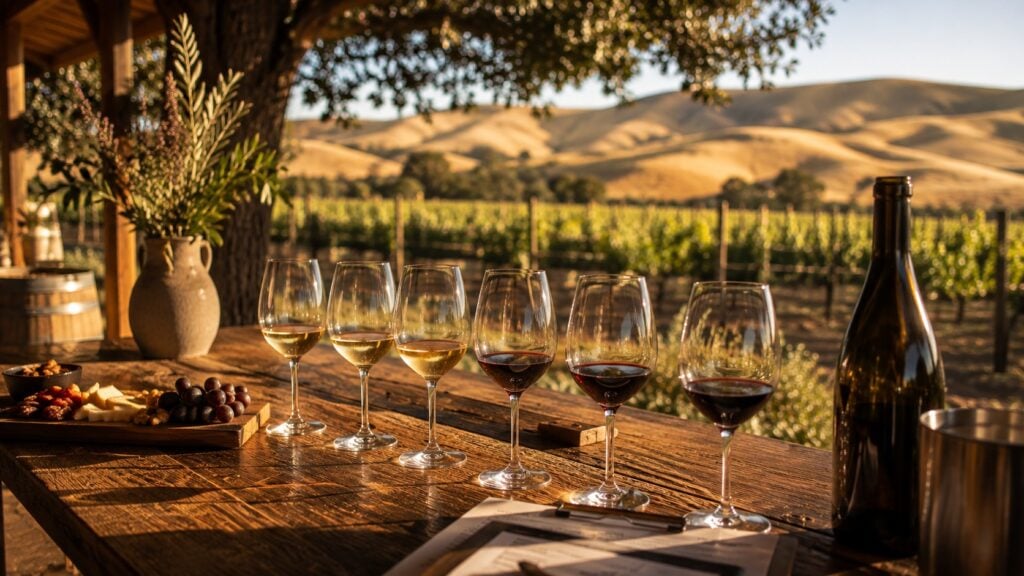
At a smaller winery, tasting can feel less like moving through a polished attraction and more like entering a conversation.
You can slow down.
You can ask why a particular vineyard was selected, why one vintage tastes different from another, or why the winemaker chose a specific approach.
You can begin connecting the flavor in your glass with an actual patch of land.
The Mitchell Katz Approach
Mitchell Katz Winery offers a useful example of this smaller-scale Livermore philosophy.
Founded in 1998, the family-owned winery focuses on handcrafted, single-vineyard wines from Livermore Valley. Its vineyard philosophy emphasizes working with select growers and keeping vineyard sites distinct rather than blending fruit across sites.
That approach is particularly relevant in a region like Livermore because it gives drinkers an opportunity to experience variation within the valley itself.
The appellation stops being an abstract name on a label.
It becomes something you can taste vineyard by vineyard.
Single-Vineyard Wines Put Livermore’s Differences on Display
Suppose two photographers stand in different parts of the same valley.
They photograph the landscape at exactly the same moment.
One faces morning light on a hillside. Another works in a shaded pocket closer to the valley floor.
Their photographs will not be identical simply because they were taken in “Livermore.”
Vineyards work similarly.
Within one wine region, different sites can create distinct expressions.
Soil composition changes. Elevation changes. Wind exposure changes. Sunlight changes. Drainage changes. Even harvest timing can differ.
Single-vineyard winemaking gives those differences room to speak.
Mitchell Katz describes its philosophy as keeping each wine tied to an individual vineyard so that the site’s characteristics remain identifiable rather than disappearing into a broader regional blend.
For wine drinkers, this can turn tasting into exploration.
You are not merely asking, “Do I like Cabernet Sauvignon?”
You can begin asking, “How does Cabernet from this particular Livermore vineyard compare with Cabernet grown somewhere else in the valley?”
That is a much more interesting conversation.
A California Wine Country Experience Near the Bay Area
Livermore has another advantage that has nothing to do with fermentation or vineyard chemistry:
Location.
The Livermore Valley wine region sits in the San Francisco Bay appellation, approximately 30 miles east of San Francisco.
That makes wine country surprisingly accessible to millions of Bay Area residents.
For someone in San Francisco, Oakland, San Jose, Pleasanton, Dublin, San Ramon, or elsewhere around the Bay, Livermore can turn wine tasting into a manageable day trip rather than a major travel project.
And accessibility changes how people can interact with a wine region.
Instead of visiting once every several years, nearby wine lovers can return.
They can follow vintages.
They can revisit favorite producers.
They can attend seasonal events and discover new releases.
They can gradually learn the differences among vineyards and varieties.
Wine country becomes less like a once-in-a-lifetime attraction and more like a local landscape worth knowing.
A Different Pace of Wine Tasting
Livermore’s accessibility is complemented by the character of many of its smaller tasting rooms.
At Mitchell Katz, for example, the winery describes its tasting experience as deliberately relaxed and personalized, with an emphasis on small-batch, single-vineyard wines.
That atmosphere can be particularly appealing to visitors who want to learn.
Wine can seem intimidating when everything feels formal.
Terms such as tannin, acidity, terroir, malolactic fermentation, oak integration, and vintage variation can make beginners feel as though they need to study before ordering a glass.
They do not.
The most useful wine education often happens through comparison.
Taste.
Ask a question.
Taste again.
Compare two wines.
Notice what changes.
A relaxed tasting environment makes that process much easier.
Why Livermore Remains Underrated
If Livermore has history, strong growing conditions, diverse varieties, and dozens of wineries, an obvious question follows:
Why isn’t it more famous?
Part of the answer may simply be California’s abundance.
Few places in the world have as many recognized wine destinations competing for attention within one state.
Napa Valley has extraordinary global name recognition. Sonoma encompasses numerous famous appellations. Paso Robles has built a powerful identity. Santa Barbara County has earned international attention. Other Central Coast regions have passionate followings of their own.
In such a crowded landscape, even a historically important region can receive less attention than its credentials warrant.
Livermore also sits within the orbit of the San Francisco Bay Area, a place internationally associated with technology, cities, and coastal landmarks.
Its vineyards can almost hide in plain sight.
Being Less Famous Can Be Part of the Appeal
There is a paradox here.
The same lack of mass-market recognition that makes Livermore underrated can make exploring it rewarding.
Discovery feels different when the destination has not been reduced to a checklist.
You can arrive without feeling obligated to chase a famous label.
Instead, you can follow curiosity.
Perhaps you discover that you prefer Petite Sirah to Cabernet Sauvignon.
Perhaps a single-vineyard Chardonnay changes your assumptions about California Chardonnay.
Perhaps you taste two wines made from the same variety but different vineyards and suddenly understand what winemakers mean when they talk about place.
Those moments are what make wine travel memorable.
Livermore Valley Versus California’s Famous Wine Regions
It is tempting to frame every lesser-known California wine destination as “the next Napa.”
Livermore does not need that comparison.
Its value comes from being itself.
Wine regions are not interchangeable products competing for a single trophy. Napa’s identity emerged from its particular geography, history, wineries, and culture. Sonoma has its own mosaic of appellations and styles. Paso Robles is different again.
Livermore has its own story.
Its warm inland climate is moderated by marine influence. Its history stretches deep into California winegrowing. Its vineyards support a broad selection of grapes. Its proximity to the Bay Area makes it unusually accessible. And its mixture of established names and smaller family producers gives visitors different ways to experience the region.
The better question is not:
“Is Livermore better than Napa?”
It is:
“What can I experience in Livermore that makes this region distinctive?”
That question leads somewhere much more interesting.
Why Livermore’s History Still Matters Today
Wine history can easily become a collection of dates.
But history matters most when it changes how we understand the present.
Knowing that Livermore produced an internationally recognized wine in 1889 changes the perception that California wine excellence appeared suddenly in the late twentieth century.
Knowing about the valley’s Chardonnay history changes how we think about the spread of that grape across California.
Knowing that the region survived Prohibition and later experienced renewed growth gives today’s wineries additional context.
Modern Livermore is not simply preserving a museum.
It is adding new chapters.
Established winegrowing families continue alongside newer producers. Traditional California varieties share space with grapes associated with Bordeaux, Rhône, Italy, Spain, and elsewhere.
That mixture of continuity and experimentation is one reason the region deserves attention now.
Why That May Be Changing
“Underrated” does not necessarily mean “unknown forever.”
Livermore has several characteristics that align well with what modern wine travelers increasingly seek: authenticity, education, local identity, vineyard specificity, accessibility, and a range of tasting experiences.
Consumers are also becoming more adventurous.
Wine drinkers can learn about an unfamiliar appellation in minutes. They can discover smaller producers online, compare varieties, read about vineyard sites, and plan a trip without relying solely on the regions traditionally featured in travel magazines.
That makes discovery easier.
And Livermore has a strong story to discover.
The Region Rewards Curious Wine Drinkers
Some wine destinations impress immediately through grandeur.
Livermore often works differently.
It rewards attention.
Learn its history and the region becomes more interesting.
Understand the marine influence and the wines begin to make more sense.
Taste across vineyards and the concept of terroir becomes less abstract.
Compare varieties and you begin to appreciate the valley’s versatility.
That is the hallmark of a wine region worth revisiting.
The deeper you look, the more there is to see.
Discovering Livermore Valley One Vineyard at a Time
Ultimately, the best argument for the Livermore Valley wine region is not a statistic, an award, or a historical date.
It is the wine.
History gives context.
Geography provides explanation.
Soil and climate provide possibilities.
Winemakers turn those possibilities into bottles.
And tasting allows you to decide what the region means to you.
For some visitors, the revelation might be a structured Cabernet Sauvignon. For others, it could be Chardonnay, Petite Sirah, Zinfandel, Sauvignon Blanc, Sangiovese, Malbec, or another unexpected variety.
For others still, the most memorable part may be sitting at a smaller family-owned winery and realizing that wine country does not need to feel complicated.
That is where Mitchell Katz fits naturally into the Livermore story.
Its single-vineyard philosophy encourages drinkers to look closer—to think not merely about a grape variety but about the particular vineyard that produced it. The winery’s current portfolio demonstrates just how many expressions can emerge from Livermore Valley.
California Wine Has More Than One Story
Perhaps that is the larger lesson.
California wine is too diverse to be represented by only a handful of famous regions.
Beyond the names recognized around the world are valleys, vineyards, families, and winemakers whose contributions deserve exploration.
Livermore Valley is one of them.
It has been growing wine grapes since the nineteenth century. Its wines earned international attention remarkably early in California’s wine history. Its vineyards helped influence California Chardonnay. Its geography brings together inland sunshine and cooling marine breezes. Its well-drained soils, diverse vineyard sites, and wide selection of grape varieties give winemakers plenty to work with.
And today, more than 50 wineries continue that story across the valley.
So why is Livermore Valley one of California’s most underrated wine regions?
Not because it needs to imitate somewhere more famous.
Quite the opposite.
Livermore deserves greater recognition because it already possesses what serious wine regions need most: history, distinctive growing conditions, talented producers, diverse vineyards, and an identity rooted in place.
Sometimes the most rewarding wine discovery is not finding the newest region.
It is finally noticing the one that has been there all along.
FAQs
Is Livermore Valley a wine region?
Yes. Livermore Valley is an officially recognized American Viticultural Area (AVA) in California. The Livermore Valley AVA was established on September 1, 1982, although commercial grape growing in the valley dates back to the 1840s.
What is Livermore Valley wine country known for?
Livermore Valley is known for its long California winemaking history, warm days moderated by cooling marine breezes, well-drained soils, and diverse grape varieties. The region also has important historical connections to California Chardonnay and Petite Sirah.
Why is Livermore Valley good for growing wine grapes?
Livermore Valley’s east-west geography allows cooling coastal fog and marine breezes to enter the valley after warm daytime temperatures. This combination can help grapes achieve ripeness while retaining freshness and acidity.
What wines are produced in Livermore Valley?
The region produces a broad range of wines, including Cabernet Sauvignon, Chardonnay, Petite Sirah, Merlot, Sauvignon Blanc, Zinfandel and varieties with Bordeaux, Rhône, Italian, and Spanish origins. Individual winery portfolios vary considerably.
How many wineries are in Livermore Valley?
The Livermore Valley Wine Community currently reports more than 50 wineries in the region. These range from very small producers to significantly larger wineries.