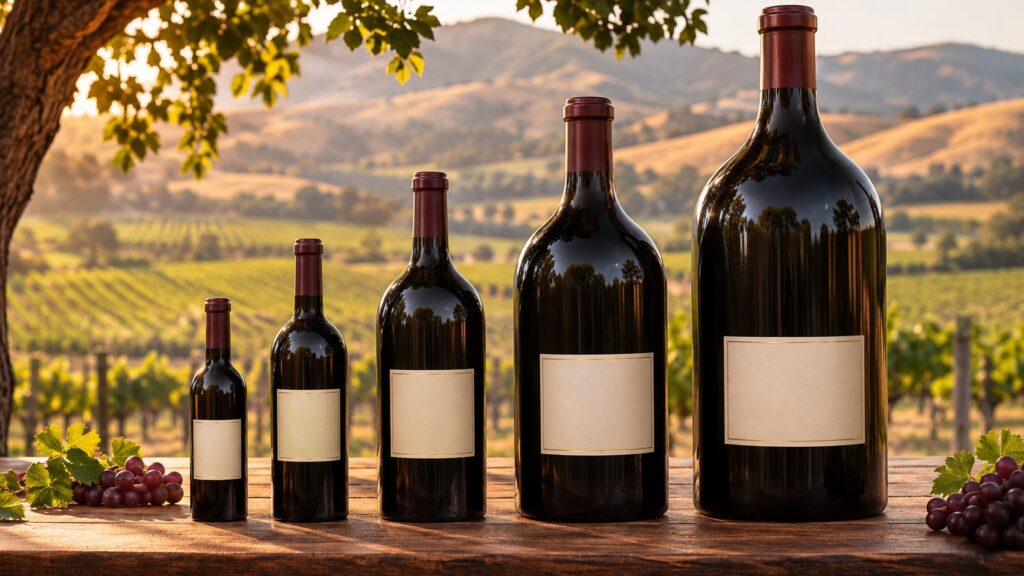
Have you ever noticed how dramatically wine bottles can differ in size? One bottle fits comfortably in your hand, while another looks large enough to become the centerpiece of an entire celebration.
Although they serve the same fundamental purpose, wine bottles come in many different capacities. Understanding wine bottle sizes helps explain everything from serving quantities to traditional wine packaging and long-term maturation.
The familiar 750ml bottle is the most common reference point. It appears throughout wine shops, restaurants, tasting rooms, and home collections, making it the standard against which other formats are compared.
However, wine packaging extends far beyond this familiar bottle. Smaller containers accommodate individual servings, while large-format bottles can hold enough wine for dozens of glasses.
Some sizes have straightforward names, such as half bottle and double magnum. Others carry historical names like Jeroboam, Methuselah, and Nebuchadnezzar, which can seem mysterious to anyone unfamiliar with wine terminology.
These differences are not merely decorative. Bottle capacity can influence convenience, presentation, storage requirements, and the rate at which certain wines develop over time.
For wine enthusiasts exploring the Livermore Valley, understanding these details adds another dimension to appreciating California winemaking. The more familiar these measurements become, the easier it is to understand the stories behind different wines and their packaging.
Complete Wine Bottle Sizes Chart
A wine bottle sizes chart provides the easiest way to compare different formats. The following measurements use a standard 750ml bottle as the reference and assume approximately 150ml for each full glass of wine.
| Wine Bottle Name | Capacity | Standard Bottle Equivalent | Approximate Glasses |
|---|---|---|---|
| Split or Piccolo | 187–187.5ml | ¼ bottle | 1 |
| Half Bottle or Demi | 375ml | ½ bottle | 2–3 |
| Half Liter | 500ml | ⅔ bottle | 3 |
| Standard Bottle | 750ml | 1 bottle | 5 |
| Liter Bottle | 1L | 1⅓ bottles | 6–7 |
| Magnum | 1.5L | 2 bottles | 10 |
| Double Magnum | 3L | 4 bottles | 20 |
| Jeroboam (Bordeaux convention) | 4.5L | 6 bottles | 30 |
| Rehoboam (sparkling wine) | 4.5L | 6 bottles | 30 |
| Imperial or Methuselah | 6L | 8 bottles | 40 |
| Salmanazar | 9L | 12 bottles | 60 |
| Balthazar | 12L | 16 bottles | 80 |
| Nebuchadnezzar | 15L | 20 bottles | 100 |
| Solomon | 18L | 24 bottles | 120 |
Note: Bottle naming conventions vary by region, particularly for 3-liter and 4.5-liter formats. Serving estimates are approximate, and U.S. labeling conventions use 187ml for the small split format.
The chart reveals how quickly wine volume increases with larger formats. A magnum holds two standard bottles, while a 9-liter Salmanazar contains the equivalent of an entire twelve-bottle case.
However, the names themselves are not always universal. A Jeroboam in Champagne traditionally holds 3 liters, while Bordeaux uses the name for a larger format, often approximately 4.5 liters.
For this reason, the bottle’s stated volume is more reliable than its traditional name. The actual measurement tells you exactly how much wine the container holds, regardless of regional terminology.
Why Is a Standard Wine Bottle 750ml?
One of the most common questions about wine bottle sizes is why the industry settled on 750ml. After all, a full liter might seem like a more straightforward measurement.
The answer involves centuries of glassmaking traditions, international commerce, and evolving packaging standards. Wine bottles were not always manufactured in consistent sizes, especially when glass production depended heavily on individual artisans.
Before industrial manufacturing became widespread, glassblowers created bottles with considerable variation. Producing containers with identical dimensions and capacities was much more challenging than it is today.
As production techniques improved, more consistent formats gradually became practical. Commercial trade also encouraged recognizable bottle measurements that could be used across different markets.
Several historical explanations attempt to account for the 750ml standard. Some connect the measurement to traditional glassblowing practices, while others associate it with wine trade between France and Britain.
Although these stories are frequently repeated, no single explanation conclusively establishes the origin of the modern standard. Its widespread adoption developed through a combination of industry practices and formal packaging conventions.
Today, 750ml remains the familiar format for many wines sold in the United States. According to the Alcohol and Tobacco Tax and Trade Bureau, this capacity equals approximately 25.4 US fluid ounces.
That amount generally provides five standard 5-ounce servings. It also offers a practical balance between manageable packaging and a quantity suitable for sharing.
The standard bottle serves another important purpose in wine education. Because its capacity is familiar, larger and smaller formats can easily be described as multiples or fractions of 750ml.
Small Wine Bottle Sizes Explained
Not every wine occasion requires a full 750ml bottle. Smaller formats provide alternatives for individual portions, limited servings, and certain specialty wine styles.
Split or Piccolo: Approximately 187ml
The split, sometimes called a piccolo, contains approximately one-quarter of a standard wine bottle. This compact format is frequently associated with sparkling wines and individual servings.
Its small capacity makes it recognizable in hospitality settings, celebrations, and travel-related service. However, not every winery produces miniature bottles, and availability varies by wine style.
Half Bottle or Demi: 375ml
A half bottle contains exactly half the volume of a standard 750ml bottle. With approximately two and a half 5-ounce servings, it offers a useful quantity between a miniature bottle and a full-size container.
Half bottles are also interesting because their smaller volume can affect wine development. Under comparable conditions, certain wines in smaller bottles may mature more quickly because oxygen exposure can be proportionally greater.
This does not mean every half bottle ages faster in exactly the same way. Closure characteristics, storage conditions, and the wine’s composition all influence its development.
Half-Liter Wine Bottle: 500ml
A 500ml bottle contains two-thirds of a standard bottle. This format sometimes appears with dessert wines and specialty products, although its use depends on the producer and market.
The half-liter size offers another example of how packaging can reflect the style of wine being sold. A wine commonly enjoyed in smaller portions may be packaged differently from one intended for conventional table service.
One-Liter Wine Bottle
A one-liter wine bottle holds approximately one-third more wine than the standard 750ml format. Although less familiar than traditional bottles, liter containers appear in selected wine categories and markets.
For comparison, one liter provides roughly six to seven 5-ounce glasses. Its straightforward measurement also makes it relatively easy to recognize without memorizing unusual bottle terminology.
Standard Bottles, Magnums, and Double Magnums
Three wine bottle sizes are particularly helpful to understand because their relationship is easy to remember. Standard bottles, magnums, and double magnums form a simple progression based on doubling capacity.
Standard Wine Bottle: 750ml
The standard wine bottle is the everyday reference point for wine packaging. It typically contains about five 5-ounce servings and fits most conventional wine racks and refrigerators.
Its familiarity makes it convenient for comparing different wines and vintages. Standard bottles are also easier to transport and handle than many oversized formats.
Magnum Wine Bottle: 1.5 Liters
A magnum holds exactly twice the wine contained in a standard bottle. That equals 1,500ml, or approximately ten 5-ounce glasses.
Magnums are commonly associated with celebrations and collectible wines because their increased capacity creates a distinctive presentation. They also attract interest from collectors because certain wines can develop more gradually in larger containers.
However, a magnum does not automatically contain superior wine. Vineyard conditions, winemaking techniques, vintage characteristics, and proper storage remain essential to overall quality.
The main distinction is that a magnum combines two standard bottles’ worth of wine into one container. This creates a different presentation and potentially a different aging environment.
Double Magnum Wine Bottle: 3 Liters
A double magnum contains 3 liters of wine, equivalent to four standard bottles. It can provide approximately twenty 5-ounce servings, depending on pouring practices.
Compared with a regular bottle, its size is immediately noticeable. Double magnums require more storage space and careful handling, particularly when the bottle itself is made from substantial glass.
In Champagne terminology, a 3-liter bottle may also be called a Jeroboam. This illustrates why bottle volume matters more than the name when comparing formats across regions.
How Many Glasses Are in Different Wine Bottle Sizes?
Calculating servings becomes much easier when bottle capacity is expressed in milliliters. A common reference pour is five US fluid ounces, which equals approximately 148 milliliters.
For convenient estimates, many wine guides round this amount to 150ml. Dividing a bottle’s capacity by 150 therefore provides an approximate number of glasses.
A standard 750ml bottle yields about five glasses. A 1.5-liter magnum provides approximately ten, while a 3-liter double magnum provides around twenty.
Larger bottles follow the same calculation. A 6-liter Imperial contains approximately forty 150ml servings, while a 9-liter Salmanazar contains approximately sixty.
Why Pour Sizes Vary
Not every glass of wine contains the same amount. Restaurants, tasting rooms, and private gatherings may use different serving sizes depending on the setting.
A tasting pour is generally smaller than a conventional full serving. Dessert wines and fortified wines may also be poured in smaller quantities because of their style or alcohol concentration.
For example, a standard bottle can provide six 125ml servings rather than five 150ml servings. The total volume remains unchanged, but the number of glasses increases when individual pours become smaller.
Understanding this distinction prevents confusion when comparing serving estimates. It also helps explain why different wine guides may report slightly different glass counts.
Understanding Glass Capacity Versus Pour Size
The physical size of a wineglass is not the same as the amount of wine it should contain. Many wineglasses are intentionally designed with extra space to allow swirling and aroma development.
A large glass does not necessarily indicate a larger serving. Measuring the actual wine volume provides a more reliable comparison than judging the amount by the glass’s shape.
Choosing Wine Bottle Sizes for Different Occasions
Bottle size can influence how wine is presented and served in different settings. Understanding those differences helps explain why some formats are more common than others.
Small Dinners and Everyday Meals
A standard bottle is familiar and relatively easy to handle during a small dinner. Its capacity provides several servings without requiring specialized equipment or substantial storage space.
A half bottle offers another possibility when less wine is needed. It can also be useful when comparing two different styles without opening two full bottles.
Family Celebrations
Magnums can create a distinctive presentation at celebrations because they hold twice as much wine as standard bottles. Their larger size makes them visually noticeable while remaining more manageable than very large formats.
However, two standard bottles provide the same total wine volume as one magnum. Smaller bottles may offer greater flexibility when serving different wines or managing temperatures.
Weddings and Large Events
Large celebrations sometimes feature oversized bottles because of their ceremonial appearance. A double magnum or an even larger format can become a memorable visual element.
Practical considerations become increasingly important as capacity grows. Larger bottles take more time to chill, weigh more when full, and can be harder to pour accurately.
Wine Gifting
A magnum can create an impressive presentation when given as a gift. Its unusual dimensions distinguish it from the familiar standard bottle.
Still, wine quality and the recipient’s preferences matter more than size alone. A thoughtfully selected standard bottle may be more meaningful than a larger format chosen purely for appearance.
Collecting and Cellaring
Some wine collectors appreciate large-format bottles because of their potential aging characteristics and relative rarity. Certain producers release selected wines in magnums or other formats specifically for collectors.
However, bottle size should never replace careful consideration of provenance and storage history. A properly stored standard bottle may be preferable to a poorly stored magnum of the same wine.
Wine Bottle Sizes and Storage
Wine storage becomes more complicated as bottle dimensions increase. Most conventional racks and refrigerators are designed primarily around the shape and size of standard 750ml bottles.
Magnums are often wider and sometimes taller than standard bottles. Double magnums and larger containers may require dedicated shelving or specialized storage arrangements.
Storage Space and Weight
A large bottle occupies more physical space than an equivalent number of standard bottles might in a tightly organized rack. Its diameter and shape can also make conventional shelving unsuitable.
Weight presents another concern because substantial glass adds to the weight of the wine itself. Secure storage surfaces are essential when handling particularly large formats.
Temperature and Environmental Conditions
Regardless of capacity, wine benefits from a stable storage environment. Excessive heat, direct sunlight, and substantial temperature fluctuations can negatively affect wine quality.
A cool, dark location is generally preferable for bottles intended for extended storage. The appropriate storage approach also depends on the wine, its closure, and its expected drinking window.
Bottle Orientation
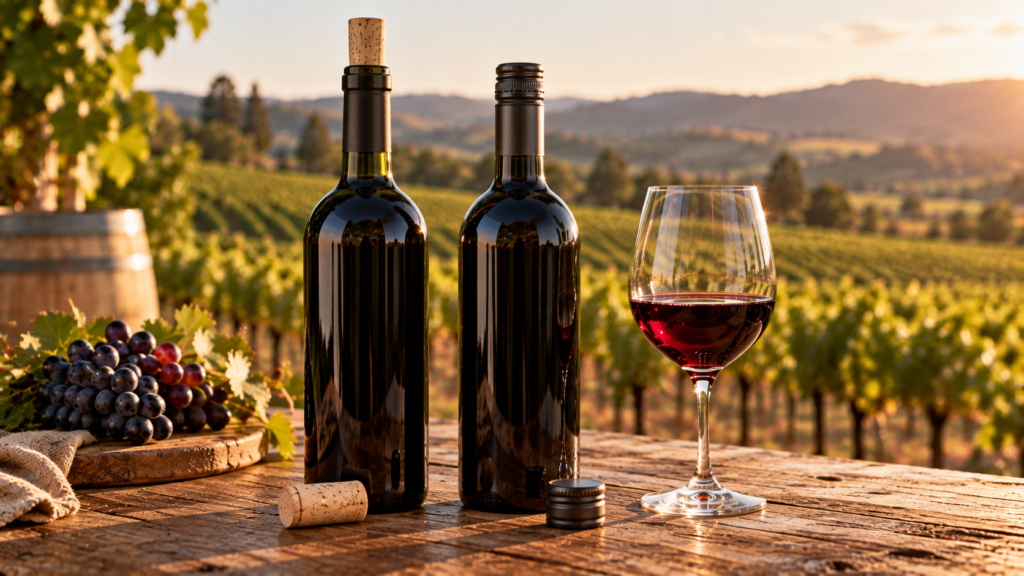
Traditional guidance often recommends storing natural-cork-sealed wines horizontally for extended periods. This practice is intended to help maintain suitable conditions around the closure, although cork performance also depends on humidity and material characteristics.
Screw-cap bottles do not require horizontal storage for the same reason. Short-term storage needs can also differ from those associated with long-term cellaring.
Does Wine Bottle Shape Matter?
Wine bottle size and wine bottle shape are related but separate characteristics. Two bottles can contain exactly 750ml while having noticeably different silhouettes.
Traditional shapes often reflect the regions where particular wines originated. Over time, these designs became recognizable visual associations for different wine styles.
Bordeaux-Style Bottles
Bordeaux-style bottles typically have relatively straight sides and pronounced shoulders. This silhouette is commonly associated with Cabernet Sauvignon, Merlot, and other Bordeaux-related grape varieties.
The shoulders historically offered a practical shape for pouring certain wines that might develop sediment. However, the bottle itself does not guarantee anything about the wine’s quality.
Burgundy-Style Bottles
Burgundy-style bottles generally feature sloping shoulders and a broader, more rounded profile. They are frequently associated with Pinot Noir and Chardonnay.
These associations developed through regional traditions rather than universal technical requirements. A winery can choose different packaging based on its intended presentation and production needs.
Champagne and Sparkling Wine Bottles
Traditional sparkling wine bottles have thicker glass and are engineered to withstand internal pressure. Their construction reflects the demands of containing wine with dissolved carbon dioxide.
Their shape may resemble Burgundy bottles, but their structural requirements are different. This illustrates why a bottle’s design can sometimes serve an important technical function.
How to Read Wine Bottle Measurements
Understanding wine bottle labels is easier when you recognize the most common volume units. Wine capacity is normally expressed in milliliters or liters rather than the height or width of the container.
For example, 750ml means 750 milliliters of liquid. A label showing 1.5L indicates 1,500 milliliters, while 3L indicates 3,000 milliliters.
Milliliters Versus Liters
One liter equals 1,000 milliliters. Therefore, converting between the two units simply involves multiplying or dividing by 1,000.
A 375ml half bottle contains 0.375 liters. A 750ml standard bottle contains 0.75 liters, and a magnum contains 1.5 liters.
These conversions are useful because small containers often display measurements in milliliters, while larger bottles use liters. Knowing both units makes comparing different formats much simpler.
Wine Bottle Volume Versus Alcohol Content
The volume printed on a bottle should not be confused with its alcohol by volume percentage, commonly abbreviated ABV. These numbers describe entirely different properties.
A 750ml bottle indicates the total quantity of liquid, while an ABV of 13.5% indicates the proportion of alcohol by volume. A larger container does not necessarily contain wine with a higher alcohol concentration.
For example, a standard bottle and a magnum of the same wine can have identical ABV percentages. The magnum simply contains twice as much wine and therefore twice the total alcohol quantity.
U.S. Wine Labeling Standards
Wine container sizes sold in the United States are subject to federal labeling and packaging rules. The Alcohol and Tobacco Tax and Trade Bureau identifies authorized fill volumes and requirements for communicating net contents.
These rules include familiar capacities such as 375ml, 750ml, 1 liter, 1.5 liters, and 3 liters. Additional approved sizes and provisions for larger containers allow for a broader range of packaging options.
For consumers, the practical lesson is straightforward. Reading the labeled net contents is the most dependable way to determine how much wine a bottle contains.
Final Thoughts: Understanding Wine Bottle Sizes
Wine bottle sizes reveal an intriguing combination of practical measurements, historical traditions, and winemaking considerations. From miniature splits to enormous Nebuchadnezzars, every format offers a different perspective on how wine is packaged and presented.
The standard 750ml bottle remains the most familiar reference, providing approximately five conventional servings. A magnum doubles that quantity, while a double magnum contains the equivalent of four standard bottles.
Larger formats introduce memorable historical names and distinctive handling considerations. They may also influence how certain wines mature, although wine quality depends on much more than packaging.
Understanding these differences makes wine terminology less intimidating and wine experiences more informative. Whether the bottle is ordinary or extraordinary, the most important story remains the wine itself, its origins, and the craftsmanship behind it.
FAQs
What is the standard wine bottle size?
A standard wine bottle contains 750 milliliters, equivalent to approximately 25.4 US fluid ounces. This is the most familiar format in wine shops, restaurants, and tasting rooms.
How many glasses of wine are in a 750ml bottle?
A standard 750ml bottle provides approximately five 5-ounce glasses of wine. Smaller tasting pours or larger servings will change the total number of glasses.
What is a magnum wine bottle?
A magnum contains 1.5 liters of wine, equivalent to two standard 750ml bottles. It provides approximately ten 5-ounce servings and is frequently associated with celebrations and wine collecting.
What is the difference between a magnum and a double magnum?
A magnum holds 1.5 liters, while a double magnum contains 3 liters. Therefore, a double magnum holds twice as much wine as a magnum and four times as much as a standard bottle.
Does wine age better in larger bottles?
Certain wines may mature more slowly in larger formats because oxygen exposure can be proportionally lower. However, aging depends on the wine’s composition, closure, and storage conditions, so larger bottles do not automatically produce better wine.