Have you ever swirled a glass of wine and noticed delicate streaks sliding down the inside of the glass?
They might look like tiny raindrops racing down a window. Some move quickly, while others seem to linger before slowly returning to the wine below.
These fascinating streaks are called wine legs, and they have inspired countless conversations among wine enthusiasts.
You may have heard someone claim that thick wine legs indicate an expensive bottle. Others believe slow-moving legs reveal a wine’s sweetness, richness, or exceptional quality.
But what are wine legs, really?
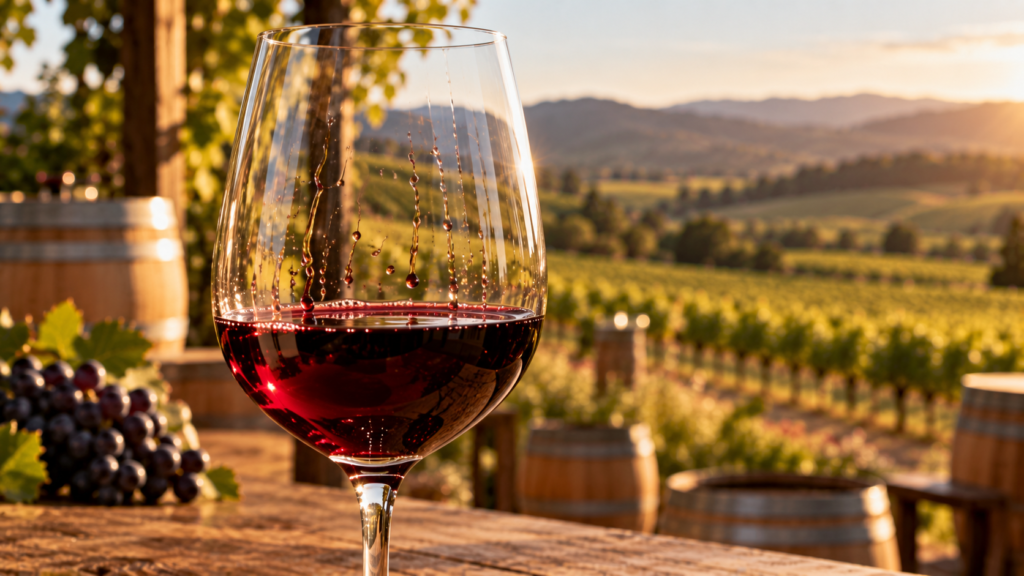
Wine legs are droplets and streaks that form along the inside of a wineglass as alcohol evaporates and differences in surface tension cause liquid to move. They are a natural physical phenomenon, not a reliable measure of wine quality.
Understanding how wine legs develop can make the experience of tasting wine more interesting. However, appreciating what they reveal also requires understanding what they cannot tell you.
At Mitchell Katz Winery in Livermore, California, we believe that learning about wine should make each glass more enjoyable, not more intimidating.
Whether you’re exploring a bold Cabernet Sauvignon, enjoying a refreshing white wine, or simply becoming more curious about what happens inside your glass, the science behind wine legs offers an intriguing perspective on an everyday experience.
Let’s explore why wine legs form, what influences their appearance, and how to interpret them without falling for common wine myths.
What Are Wine Legs?
Wine legs are the thin streams or droplets of liquid that appear on the inside surface of a wineglass, usually after the wine has been swirled.
They are also commonly called wine tears or cathedral arches.
These names describe the same phenomenon, although they emphasize different visual characteristics.
Wine legs resemble narrow trails running down the glass. Wine tears refer to the droplets that gather before falling, while cathedral arches describe the curved patterns that sometimes appear around the bowl.
You can observe them in red wine, white wine, rosé, and even certain fortified wines.
Although swirling makes them easier to notice, wine legs can also appear without deliberate swirling.
When wine coats the glass, some liquid remains attached to its inner surface. As the alcohol in this thin film evaporates, changes in surface tension encourage the remaining liquid to move.
Eventually, gravity pulls the accumulated droplets downward.
The result is the familiar pattern of streaks running toward the wine.
Interestingly, the appearance of these streaks can change considerably depending on the wine’s composition, the glass itself, and the surrounding environment.
That variability is one reason wine legs are such an unreliable indicator of quality.
What Causes Wine Legs to Form?
The formation of wine legs begins with two familiar ingredients: alcohol and water.
Wine contains both, along with acids, sugars, tannins, aromatic compounds, and other dissolved substances.
These components interact in ways that influence how liquid behaves along the surface of a glass.
Alcohol evaporates more readily than water under ordinary conditions. It also has a lower surface tension than water. Surface tension describes the forces that help hold the surface of a liquid together.
You can see surface tension in action when water forms a rounded droplet on a smooth surface.
When you swirl your wine, a thin layer of liquid spreads upward along the inside of the glass. Alcohol begins evaporating from that thin layer.
As the alcohol concentration changes, the surface tension of the remaining liquid changes as well.
These differences cause liquid to move along the glass, where it can accumulate into small ridges and droplets.
Once those droplets become heavy enough, gravity draws them downward. You see the resulting streams as wine legs.
The process is entirely natural and does not require any special winemaking technique.
Even an ordinary glass of wine can demonstrate this phenomenon.
The scientific explanation becomes particularly interesting when we examine the forces responsible for moving the liquid.
The Science Behind Wine Legs: Understanding the Marangoni Effect
The physical process responsible for wine legs is commonly associated with the Marangoni effect.
Although the name may sound complicated, the basic principle is surprisingly approachable.
The Marangoni effect describes how differences in surface tension can cause a liquid to flow along an interface.
Imagine two areas of a liquid surface.
One has relatively low surface tension, while the other has higher surface tension.
The difference creates forces that move liquid toward the region with higher surface tension.
In a wineglass, the evaporation of alcohol helps create these differences.
Step 1: Wine Coats the Glass
When you swirl wine, a thin film spreads along the inner surface.
This film contains alcohol, water, and the wine’s other dissolved components.
Step 2: Alcohol Begins to Evaporate
Alcohol evaporates from the thin film, changing its composition.
As the alcohol concentration decreases in certain areas, surface tension increases.
Step 3: Surface Tension Creates Movement
The difference in surface tension encourages liquid to flow upward along the glass.
This movement can produce a ridge of liquid above the main body of wine.
Step 4: Droplets Begin to Form
The ridge becomes unstable in places.
Small droplets develop and gradually grow as additional liquid accumulates.
Step 5: Gravity Pulls the Droplets Downward
Eventually, gravity overcomes the forces supporting the droplets.
They descend along the glass as visible wine legs.
Researchers have studied this behavior for generations, including the ways that flowing liquid can develop ridges and unstable patterns.
Wine Enthusiast discusses the scientific research behind this unusual movement in its explanation of how wine legs form.
The surprising detail is that liquid may initially move upward even though the droplets ultimately travel downward.
What appears to be a simple dripping pattern actually involves competing physical forces.
That’s part of what makes wine science so fascinating.
An everyday glass of wine can demonstrate principles that scientists also study in fluid dynamics.
Do Wine Legs Indicate a High-Quality Wine?
One of the most persistent misconceptions about wine legs is that they reveal the quality of the wine.
You might hear someone say that a glass with thick, dramatic legs must contain an exceptional vintage.
Unfortunately, the relationship isn’t that straightforward.
Wine legs are not a reliable indicator of wine quality.
Their appearance primarily reflects physical properties and environmental conditions rather than craftsmanship, complexity, or balance.
A beautifully balanced wine may display subtle legs.
A less enjoyable wine might produce particularly prominent streaks.
Neither observation tells you whether the wine will taste good.
Consider two glasses.
The first contains a carefully crafted wine with balanced acidity, expressive aromas, and a pleasant finish.
The second contains a wine with higher alcohol content but less harmony among its flavors.
The second glass might develop more noticeable legs under the same conditions.
That doesn’t mean it offers a more enjoyable drinking experience.
It simply means the liquids behave differently.
What Actually Makes Wine Enjoyable?
Wine appreciation involves several sensory characteristics working together.
These include aroma, flavor, acidity, tannin structure, balance, texture, and finish.
A wine might display inviting aromas of blackberry, cherry, citrus, or floral notes.
Its acidity may create freshness, while its tannins contribute structure.
The flavors may develop as the wine moves across your palate.
These characteristics reveal much more about the drinking experience than the streaks on the glass.
Wine legs are interesting to observe, but they cannot replace smelling and tasting the wine.
What Do Wine Legs Tell You About Alcohol Content?
Although wine legs cannot establish quality, they may offer a limited clue about alcohol content.
Alcohol plays a central role in the formation of wine legs because its evaporation changes surface tension.
Under comparable conditions, a wine with a higher alcohol concentration may produce more noticeable droplets.
However, this relationship is not precise enough to determine alcohol by volume simply by looking at a glass.
Two wines with similar alcohol levels can display different leg patterns.
Likewise, wines with different alcohol levels can produce surprisingly similar streaks.
Temperature, humidity, glass shape, cleanliness, and other dissolved substances can all influence the result.
Can You Estimate Alcohol Percentage From Wine Legs?
Not accurately.
You cannot reliably distinguish a wine containing 13% alcohol from one containing 14.5% alcohol based on its legs alone.
The visual differences are affected by too many other variables.
For an accurate alcohol measurement, consult the alcohol-by-volume information on the wine label.
The label provides a more useful reference than subjective interpretations of droplet thickness.
Why Higher-Alcohol Wines May Produce More Noticeable Legs
A higher concentration of alcohol can contribute to stronger evaporation-driven surface-tension differences.
That may encourage the formation of visible droplets under suitable conditions.
However, higher alcohol does not guarantee thicker or slower-moving legs.
A wine’s overall composition and its surroundings still matter.
Think of wine legs as a possible clue rather than a measuring instrument.
They may encourage curiosity about alcohol concentration, but they cannot confirm it.
Do Thick or Slow-Moving Wine Legs Mean a Sweeter Wine?
Another common belief is that slow-moving wine legs indicate sweetness.
There is some physical reasoning behind this idea, but it needs an important qualification.
Sugar can influence a wine’s viscosity.
Viscosity describes a liquid’s resistance to flowing.
Honey, for example, has a much higher viscosity than water.
Because it resists flowing, honey generally moves more slowly.
Wine containing substantial residual sugar may also be more viscous than an otherwise comparable dry wine.
This can influence the behavior of droplets on the glass.
However, the difference between typical dry wines and sweeter wines is not always visually obvious.
Alcohol content, temperature, and other components complicate the picture.
Does a Dry Wine Have Legs?
Absolutely.
Dry wines can develop prominent wine legs even when they contain very little residual sugar.
This happens because alcohol evaporation and surface tension remain active regardless of whether a wine tastes sweet.
A dry Cabernet Sauvignon, for instance, may display pronounced streaks.
That doesn’t make the wine sweet.
Similarly, a sweeter wine may not always produce the most dramatic legs in a particular glass.
Can Wine Legs Tell You How Much Sugar Is Present?
No.
Although dissolved sugar can affect viscosity, visual observations cannot accurately determine residual sugar concentration.
A wine’s sweetness is better assessed through its flavor and, when available, technical information about its residual sugar.
It’s also important to remember that perceived sweetness can be affected by acidity, fruit character, and alcohol.
A wine with ripe fruit flavors may seem sweet even when it is technically dry.
Wine legs cannot resolve those sensory distinctions.
Why Do Some Wines Have More Visible Legs Than Others?
If you’ve compared several wines side by side, you may have noticed that some develop obvious droplets while others show only faint streaks.
There are several explanations.
Differences in Alcohol Concentration
As discussed earlier, alcohol influences the surface-tension gradients responsible for wine legs.
Different alcohol concentrations can therefore create different patterns.
Differences in Residual Sugar
Sugar and other dissolved substances affect the physical characteristics of wine.
In some wines, these differences can influence how droplets gather and move.
Differences in Temperature
A warmer wine may experience faster alcohol evaporation than the same wine served colder.
The resulting change in evaporation behavior can influence leg formation.
Differences in Glassware
The shape and surface condition of a glass affect how liquid spreads, adheres, and moves.
Even two glasses containing the same wine may produce visibly different streaks.
Differences in the Surrounding Environment
Humidity and airflow affect evaporation.
Because evaporation helps drive wine-leg formation, environmental differences can alter the appearance of droplets.
These factors demonstrate why wine legs should always be interpreted cautiously.
A visible difference does not necessarily indicate an important difference in flavor.
Red Wine vs. White Wine: Are Wine Legs Different?
Wine legs appear in both red and white wines.
The scientific mechanism is the same, regardless of color.
However, individual wine styles may produce different patterns because their chemical compositions differ.
Wine Legs in Red Wine
Red wines often attract attention because their darker color makes droplets and streaks easier to observe.
Some reds contain relatively high alcohol levels and substantial amounts of dissolved compounds.
Both characteristics can influence how liquid behaves inside the glass.
For example, a bold Cabernet Sauvignon may display visible legs after swirling.
A lighter red wine may exhibit a different pattern.
However, grape variety alone cannot predict the appearance of wine legs.
Wine Legs in White Wine
White wines can produce wine legs just as readily.
Depending on the lighting and glass shape, their transparent appearance may make the droplets less immediately noticeable.
A dry Chardonnay or Sauvignon Blanc can form delicate streaks.
A richer white wine may exhibit more pronounced droplets under certain conditions.
The important distinction is that color itself does not cause wine legs.
Alcohol evaporation and surface tension remain the primary explanation.
What About Rosé and Fortified Wines?
Rosé wines also develop legs.
Their appearance depends on their composition and the conditions in which they are served.
Fortified wines, which typically contain more alcohol than ordinary table wines, may display especially noticeable legs.
Some fortified wines also contain substantial residual sugar.
When both alcohol and sugar are present at elevated levels, their combined influence can make the pattern particularly striking.
Even then, dramatic legs do not prove that one wine is better than another.
They simply illustrate differences in physical behavior.
How Temperature, Humidity, and Glassware Affect Wine Legs
Many people assume that wine legs depend entirely on the liquid inside the glass.
In reality, the environment matters, too.
Imagine pouring the same wine into two different glasses.
You place one in a warm room and the other in a cooler setting.
After swirling both, you might observe different patterns.
The wine hasn’t changed in any meaningful qualitative sense.
Its surroundings have.
Temperature and Evaporation
Warmer conditions generally encourage alcohol to evaporate more quickly.
This can change the rate at which surface-tension differences develop.
Colder conditions can slow evaporation and alter the resulting pattern.
That means a wine’s legs may appear different when served at different temperatures.
Humidity and Airflow
Humidity also influences evaporation.
Dry air and humid air can create different evaporation conditions.
Air movement may further change the behavior of the thin film coating the glass.
These effects help explain why observations made in different rooms are not always directly comparable.
Glass Shape and Surface Condition
A wineglass is more than a decorative vessel.
Its curvature influences how wine spreads when swirled.
Its surface condition affects how readily droplets form and travel.
A glass with detergent residue or other contaminants may behave differently from a thoroughly rinsed, clean glass.
Water spots and fingerprints can also make it harder to observe consistent patterns.
For a meaningful visual comparison, use similar clean glasses under similar conditions.
Even then, remember that the experiment provides an observation, not a definitive assessment of quality.
How to Observe Wine Legs During a Tasting
You don’t need professional equipment or advanced knowledge to observe wine legs.
A clean wineglass, a small pour, and a little patience are enough.
The process can be a fun way to introduce the science of wine into an ordinary tasting.
Step 1: Choose a Clean Wineglass
Select a transparent wineglass with a smooth interior.
Make sure it is clean and free from obvious residue.
A stemmed glass can make swirling easier, although a stem is not required.
Step 2: Pour a Small Amount of Wine
Pour enough wine to create a shallow pool in the bowl.
Avoid overfilling the glass.
Leaving space makes it easier to swirl without spilling.
Step 3: Swirl Gently
Move the glass in small circles.
You can keep its base resting on a tabletop if that feels more comfortable.
The goal is to coat part of the inside surface with a thin film of wine.
There is no need for vigorous movement.
Step 4: Stop and Observe
Hold the glass still and watch the liquid settle.
Look just above the surface of the wine.
You may notice a thin ridge developing, followed by droplets and downward-moving streaks.
These are the wine legs.
Step 5: Notice the Pattern
Observe whether the droplets are widely spaced or closely grouped.
Do they appear quickly?
Do they linger?
Do they form long streaks or short trails?
These observations can make you more aware of the fluid’s behavior.
However, avoid assigning a quality rating based on what you see.
Step 6: Compare Under Similar Conditions
If you’re comparing two wines, use matching glasses.
Keep both wines at similar temperatures and observe them in the same location.
This reduces some of the environmental differences that might otherwise influence your observations.
Even with these precautions, visual results should not be treated as accurate measurements of alcohol or sugar.
Step 7: Return Your Attention to Aroma and Flavor
Once you’ve observed the legs, smell the wine.
Notice its aromas, then take a small sip.
Compare the sensory experience with your expectations.
You might discover that a wine with subtle legs offers intense flavors, while another with dramatic streaks tastes remarkably light.
That contrast illustrates why appearance alone is insufficient.
What Should You Look for Instead When Evaluating Wine?
If wine legs aren’t reliable indicators of quality, what should you focus on during a tasting?
The most useful approach combines aroma, flavor, texture, balance, and personal preference.
Each characteristic contributes something different.
Aroma: The First Impression
Before sipping, bring the glass toward your nose.
Notice the scents that emerge.
You might detect fresh berries, citrus, stone fruit, flowers, spices, or earthy notes.
Some wines also reveal aromas associated with oak aging, such as vanilla or toasted wood.
Aromas can change as the wine interacts with air and warms slightly.
Give yourself time to notice those developments.
Acidity: The Sense of Freshness
Acidity contributes brightness and freshness.
A wine with noticeable acidity may create a mouthwatering sensation.
Acidity also interacts with sweetness, fruit flavors, and other structural elements.
A well-balanced wine does not necessarily need extremely high or low acidity.
What matters is how its components work together.
Tannins: Texture and Structure
Tannins are compounds commonly associated with grape skins, seeds, and other sources, including oak.
They can create a drying or gripping sensation in the mouth.
Some wines feature firm, pronounced tannins.
Others feel softer and smoother.
Tannin intensity alone does not establish quality.
The relationship between tannins, acidity, fruit concentration, and alcohol is often more informative.
Body: How the Wine Feels
Wine body describes its perceived weight and fullness in the mouth.
Some wines feel light and delicate.
Others seem rounder, richer, or more substantial.
Alcohol, dissolved substances, and other compositional factors can influence body.
Although body and wine legs may sometimes be associated with similar underlying characteristics, one cannot reliably establish the other.
Balance: How Everything Works Together
Balance describes how the wine’s various components interact.
A wine may have pronounced acidity, firm tannins, or substantial alcohol while still offering a harmonious overall impression.
Another wine may feel dominated by one characteristic.
Balance is best assessed through tasting rather than visual inspection.
Finish: What Happens After the Sip
The finish refers to the sensations that remain after swallowing or spitting out the wine.
You might notice lingering fruit flavors, spice, acidity, or other characteristics.
The duration and character of the finish can contribute to your overall impression.
Personal Preference Still Matters
Wine appreciation is not simply a competition to identify the most technically complex bottle.
Individual preferences shape the experience.
Some people enjoy bold, structured reds.
Others prefer refreshing whites or softer, fruit-forward styles.
Learning to describe what you enjoy can be more useful than trying to interpret every visual characteristic as a sign of quality.
Wine legs add an interesting observation to the process, but your senses provide a far richer picture.
Final Thoughts: Appreciating What Wine Legs Really Reveal
So, what are wine legs, and what do they really tell you?
They are the droplets and streaks that form along the inside of a wineglass as alcohol evaporation and surface-tension differences create movement in a thin film of wine.
Their formation is associated with the Marangoni effect, a fascinating example of fluid dynamics visible during an ordinary tasting.
Although alcohol concentration, residual sugar, temperature, humidity, and glassware can influence their appearance, wine legs do not reliably indicate wine quality, price, or aging potential.
A wine with dramatic legs is not necessarily superior to one with subtle streaks.
Likewise, a dry wine can display prominent legs, and a white wine can exhibit the same phenomenon as a red wine.
The real value of understanding wine legs lies in recognizing how science contributes to the experience of enjoying wine.
At Mitchell Katz Winery, the relationship between wine education and wine appreciation is part of the pleasure of exploring Livermore Valley wines.
From the physical behavior of wine inside a glass to the aromas, textures, and flavors that emerge during tasting, every detail offers another opportunity to learn.
Ultimately, the most rewarding way to understand a wine is to experience it thoughtfully.
Notice its appearance. Explore its aromas. Pay attention to how it feels and tastes.
And the next time you see those delicate droplets descending along your glass, you’ll know that you’re witnessing an interesting scientific phenomenon and not a secret quality rating.
Sometimes, the most fascinating thing about wine is understanding why the simplest details happen.
FAQs
What are wine legs?
Wine legs are the droplets and streaks that appear along the inside of a wineglass. They form as alcohol evaporates from a thin film of wine, creating differences in surface tension that cause the liquid to move and eventually drip downward.
Do wine legs indicate good quality wine?
No. Wine legs are not a reliable indicator of wine quality. Their appearance depends on factors such as alcohol concentration, residual sugar, temperature, humidity, and glassware. Flavor, aroma, balance, and structure provide more meaningful information about the drinking experience.
Do more wine legs mean higher alcohol content?
Not necessarily. Higher alcohol concentrations can contribute to more noticeable wine legs under comparable conditions, but other variables affect their appearance. The alcohol-by-volume information on the bottle provides a more accurate measurement.
Why do some wines have thick legs?
Thicker-looking wine legs can result from interactions among alcohol, dissolved substances, and environmental conditions. Certain wines with substantial alcohol or residual sugar may develop more prominent droplets, but thickness alone cannot establish a wine’s composition.
Do wine legs indicate sweetness?
Wine legs cannot reliably determine sweetness. Although sugar can influence viscosity and droplet movement, dry wines can also exhibit pronounced legs. Tasting the wine or consulting its residual sugar information provides a better indication.